
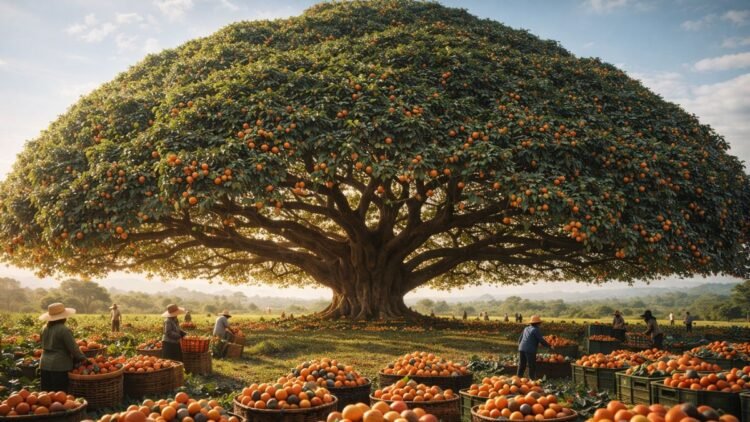
From a hilltop, it looks like a dense forest. A green dome swallows the horizon, its branches tangled into a vast mass. Birds weave in and out, and clearings of lighter and darker shades hint at the sun breaking through.
The air smells of soil, sap, and something faintly sweet — ripe fruit left in the sun. Then a guide places his hand on a single enormous trunk and says: “This is all one tree.”
It’s hard to believe, but this single tree covers 8,500 square meters, rises 20 meters high, and produces around 80,000 fruits every harvest. It’s a living myth, blending natural wonder with biological reality.
The “Forest” That’s Actually One Tree
Under its canopy, the experience is almost disorienting. Light shifts, and dozens of trunks rise, twisted and muscular, some curving impossibly. Many trunks knit back into the ground or arc sideways like bridges.
What appears to be multiple trees is in fact one organism, each branch connecting to the same root system.
Locals joke the tree has its own “postal code.” Farmers from neighboring villages rest in its shade, trade stories, and collect its fruits during harvest. The 80,000 figs, apples, or jackfruits (depending on species) attract birds, bees, and people alike.
Children climb the lower branches like playground equipment, while elders watch the canopy sway in the wind. The tree is not just a plant — it’s a landmark, a compass, a community hub.
Facts About This Giant Tree
| Feature | Detail | Significance |
|---|---|---|
| Area Covered | 8,500 m² | Comparable to a small city block, appearing as a forest from above |
| Height | 20 meters | Towering canopy with massive branches |
| Fruit Production | 80,000 fruits per harvest | Provides food for people, wildlife, and pollinators |
| Trunk & Branch Structure | Multiple connected trunks | Creates the illusion of a forest while being a single organism |
| Community Role | Shade, gathering space, harvest source | Acts as a social and ecological hub |
How a Single Tree Becomes a World
Walking beneath the canopy reveals micro-environments. On the eastern side, where light is softer, birds nest low, and fruits ripen first. On the western edge, leaves are thicker, shielding against harsh afternoon sun. The tree shifts resources through its network of roots and branches, managing its internal climate.
Farmers have learned the tree’s patterns over generations. Northern fruits bruise less, goats prefer inner leaves, and microclimates affect harvest timing. While science explains vegetative expansion and resource optimization, life under the tree feels like a myth brought into reality.
Lessons From Slow Growth
This tree didn’t reach its current size quickly. It grew decade by decade, adding small increments of bark, root, and branch each season. From one perspective, growth feels invisible; over ten or twenty years, new clusters appear, expanding its canopy.
Its slow, steady expansion mirrors human efforts that compound over time: projects, habits, or relationships. By starting with a core, expanding in small increments, protecting resources, and nurturing roots, growth can become sustainable and astonishing, even if initially invisible.
This tree challenges our perception of scale and growth. One organism, covering 8,500 square meters, producing 80,000 fruits, and rising 20 meters tall, creates a miniature world beneath its canopy. It is a living testament to slow, steady growth, quietly shaping ecosystems, communities, and imaginations alike.
FAQs
How can one tree look like a forest?
The tree spreads through multiple trunks and branches rooted into the ground, creating the illusion of a forest while remaining a single organism.
How many fruits does the tree produce?
Approximately 80,000 fruits per harvest, which attract wildlife and provide a substantial yield for local communities.
How tall and wide is the tree?
It stands 20 meters high and covers 8,500 square meters, making it appear like a forest from a distance.