
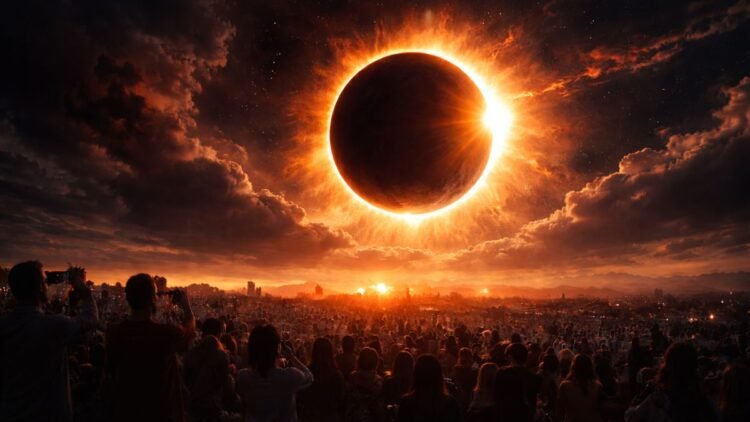
Have you ever watched the Sun shrink into a thin, bitten crescent and felt the air change before the light does? Birds go still, dogs stare blankly, and even the busiest people look up as if reality itself just paused.
Now imagine that strange twilight not lasting a few precious moments, but stretching on for more than six minutes — long enough for time to feel elastic, for your senses to adjust, and your brain to whisper: “This feels wrong… and amazing.”
Astronomers say there is a date this century when daytime will truly flirt with night for an exceptionally long stretch. It’s on the calendar — and here’s everything you need to know.
What Is a Total Solar Eclipse?
A total solar eclipse occurs when the Moon passes directly between Earth and the Sun, completely obscuring the Sun’s bright disk. At that moment, daylight dims into an eerie twilight, the Sun’s glowing edge (the corona) becomes visible, and the sky darkens as if night is arriving early.
Partial eclipses — where only part of the Sun is blocked — are more common and often feel like a dimming. But totality — when the Sun is fully covered — is what turns day into a momentary night.
Record Eclipse of the Century — What Happened in 2009
The longest solar eclipse of the 21st century occurred on July 22, 2009. For a narrow path across Earth — from India to China and out over the Pacific — totality lasted an incredible 6 minutes and 39 seconds, near the theoretical maximum possible on Earth.
People in cities like Chongqing, China watched rush‑hour daylight fade into evening‑like dimness. Cars slowed, offices filled with faces at windows, and the sky looked like a 360° sunset. Observers at sea called it “an unnatural pause in the day” — long enough to adjust instruments, take precise measurements, and simply stare.
In many ways, that eclipse is still talked about like a once‑in‑a‑lifetime concert — and it almost was.
Solar Eclipse Facts & Figures
| Feature | Details |
|---|---|
| Event Name | Total Solar Eclipse (Record Eclipse) |
| Date | July 22, 2009 |
| Longest Totality Duration | 6 minutes 39 seconds |
| Maximum Possible (Theoretical) | ~7 minutes |
| Visibility Path | India → China → Pacific regions |
| Corona Visibility | Yes — only during totality |
Why Some Eclipses Last So Long
Totality duration depends on three main factors:
- Distance of the Moon from Earth: When the Moon is closer to Earth, it appears larger in the sky, covering the Sun more effectively.
- Earth’s Distance from the Sun: When Earth is slightly farther from the Sun, the Sun appears smaller, making total coverage easier.
- Path Across Earth’s Surface: Near‑equatorial regions of Earth rotate under the Moon’s shadow faster, extending the time that the Moon’s shadow stays over a given spot.
When all three align — as in 2009 — totality can stretch to extraordinary lengths.
How to Truly Experience a Long Eclipse
Standing under a long total solar eclipse isn’t like watching a quick celestial blink — it’s more like watching a short performance. Here’s how to experience it fully:
1. Start Early
The first stage begins an hour or more before totality when the Moon starts to bite into the Sun. Wear certified eclipse glasses and notice how the light changes — sharper, thinner, almost metallic.
2. Be Present During Totality
When totality starts — that final “bead” of sunlight disappears — put the gadgets down. Take one or two photos at most, then simply watch. Feel the temperature drop, hear the silence, see the horizon glow like a 360° sunset.
3. Observe Wisely
During totality:
- View the corona with naked eyes — the only safe time to do so.
- Look for stars and planets appearing in daylight.
- Notice animal behavior — birds and insects react instantly.
As one astronomer recalled from the 2009 eclipse:
“At first I tried to photograph every second. Then I realized — I’m wasting my eclipse. So I just stared. Six minutes felt like twenty.”
Where to Watch Future Long Eclipses
Although the 2009 event holds the record this century, several notably long eclipses are still on the calendar for decades to come — each long enough to transform a routine day into a memory that outlives your photos.
Eclipse chasers plan years ahead, saving, traveling across oceans, and rearranging life plans. After all, moments like these don’t happen every day.
A long total solar eclipse isn’t just an astronomical event — it’s an experience that rewires your sense of time and place. The stillness in the air, the hush of life around you, and the surreal horizon glow are moments that stay with you long after the Sun returns and daylight resumes.
FAQs
1Why does totality feel so strange?
The sudden drop in light, temperature shift, and horizon glow mimic nighttime but with twilight colors — a sensory mix that feels surreal and unforgettable.
How long can totality last?
In rare eclipses like 2009, totality can stretch beyond six minutes. The physical limit for this century is around 7 minutes.
Can I look at the Sun during an eclipse?
Only during totality — when the Sun is fully covered — is it safe to view with the naked eye. Outside of totality, you must use certified eclipse glasses.